What will DDR6 offer?
DDR5 memory chips have arrived, so it's time for predictions of the future…
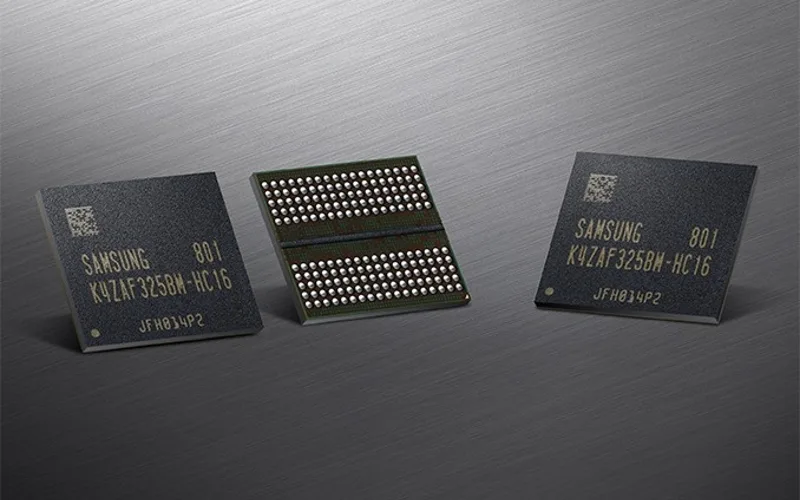
DDR5 memory circuits supporting Intel's 12th generation Alder Lake processors have just hit the market, but of course technological development does not rest. At its Tech Day 2021 event, Samsung also revealed some information about the upcoming GDDR6+, GDDR7 memories, as well as DDR6, which is said to provide twice the speed of DDR5.
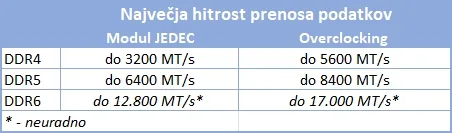
Given that DDR5 has only just hit the market and that even JEDEC (the Microelectronics Standardization Bureau) has yet to produce standards for DDR6, and memory circuits supporting it are not expected before 2025, there is a little that is already known. Standard modules or circuits should allow up to 12,000 MT/s, but if we "overclock" them (raise the frequency above the JEDEC standard) up to 17,000 MT/s, which is twice as much as the existing DDR5 and four times as much as the DDR4 that you probably have in your "machine" now.
You probably noticed the MT/s label. No, we didn't screw up. It is a unit that stands for millions of transfers per second, which is not the same as MHz. The most important difference between MT/s and MHZ is in the designation DDR (Double Data Rate), which means that twice the amount of data is transferred in one cycle. If you have, for example, a DDR4 circuit with 2666 MT/s in your computer, this means that it works with a clock speed of 1333 MHz. From a technical point of view, the units are not quite comparable, as one indicates the amount of transferred data, and the other the clock, but for ease of understanding, it is more logical to use MT/s, so many manufacturers no longer indicate the MHz unit, or it is written in some bracket.
What about GDDR6+ and GDDR7? According to Samsung, GDDR6+ will be a transitional model between DDR6 and DDR7 and will be expected to reach speeds of up to 24 MT/s, and GDDR7 up to 32 MT/s. But if the release of DDR6 is planned for 2025, we will not get successors until the end of the decade. However, technologically speaking, this is an eternity, and no one knows what will happen in the meantime. It is possible that some completely new technology will be developed that will turn everything upside down.
Source: ComputerBase
AI translated